
Bustier Midi or Full-Length Maxi? Choosing a Hem for Grass, Gravel, and Long Outdoor Events
Choose by the ground you will be standing on, not by the dress code. A full-length maxi hem drags on grass, catches on gravel, and picks up dirt at every outdoor venue with an unpaved surface; a shorter fitted bustier dress with a slit clears all of it. Reverse that on a paved terrace or an indoor reception in the evening, where a maxi's length reads more formal and there is nothing to catch on.
Terrain first, then temperature, then formality. That order will get the decision right more often than reading the invitation twice.
Why hem length is really a terrain question
An outdoor summer event puts you on one of four surfaces: lawn, gravel or crushed stone, decking or paving, or sand. Each behaves differently with a long hem.
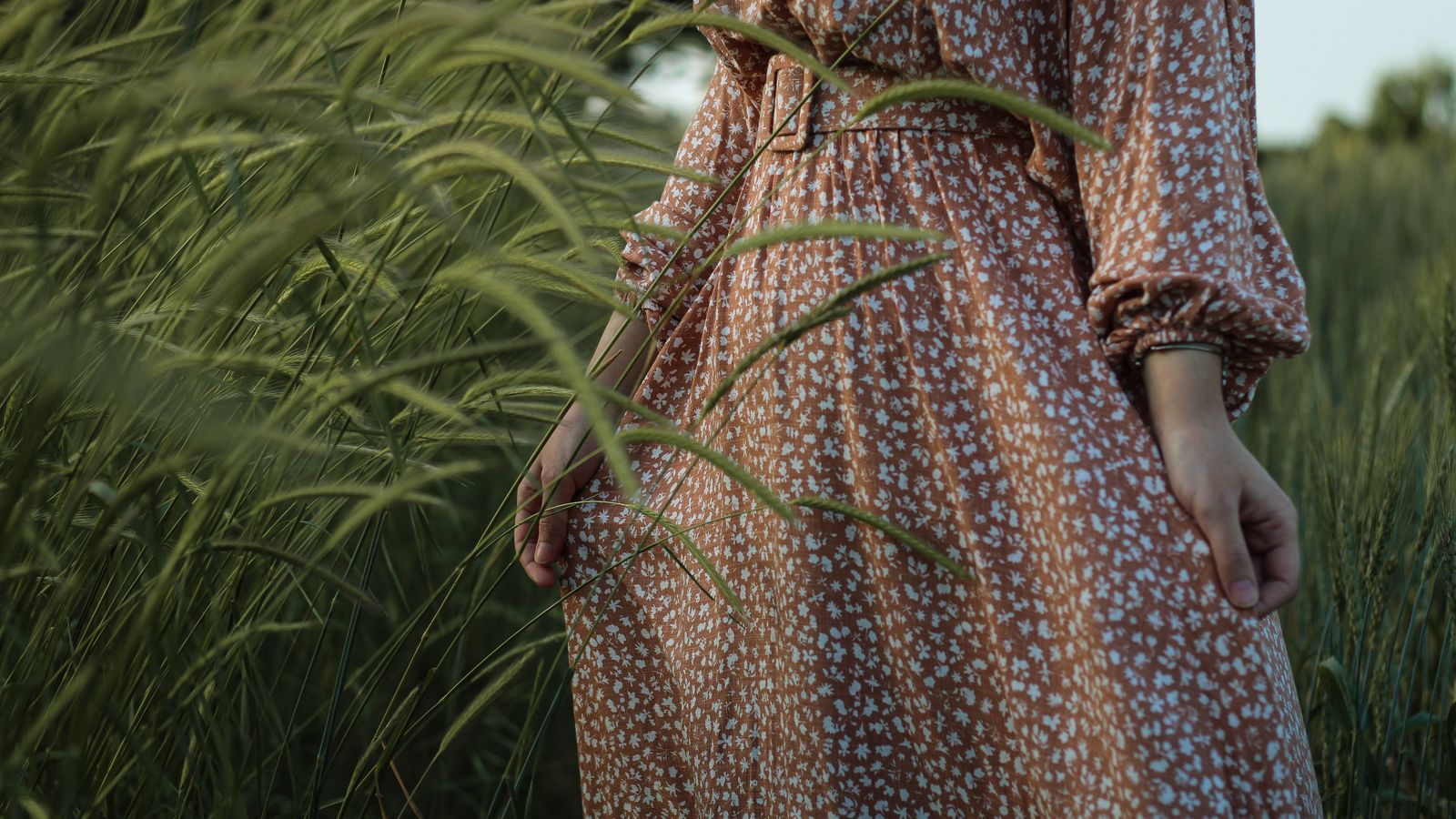
- Lawn. Grass is damp for most of the morning and evening even when it has not rained. A maxi hem wicks that moisture up several inches, and the dampness stays with you all day.
- Gravel and crushed stone. The genuine hazard. A long hem catches on stone edges and a loose thread turns into a pull. Gravel also throws dust onto the lowest few inches of any dress.
- Decking and paving. Fine for any length. Watch for gaps between boards catching a hem in heels.
- Sand. A long hem collects sand in the hem allowance, where it stays until it is washed out.
Direct comparison

Photo by Fabricio Miranda on Pexels
| Factor | Fitted bustier dress with a slit | Traditional full-length maxi | |---|---|---| | Grass and gravel | Clears the ground entirely | Hem gets damp and dirty | | Walking distance | Slit allows a full stride | Narrow maxis restrict; full skirts tangle | | Heat and humidity | Slit adds airflow | Full-length skirt holds heat | | Formality signal | Daytime to smart evening | Reads more formal after dark | | Waist definition | Built in, and adjustable | Depends on cut or a separate belt | | Getting dressed alone | Side zipper plus back lacing | Usually a back zipper | | Sitting at a long table | Easy, hem stays clear | Skirt gathers underfoot and on chair legs | | Wind | Slit can open more than intended | Full skirt lifts as a whole | | Photographs on uneven ground | Consistent silhouette | Hem line goes uneven on a slope | | Packing for travel | Less fabric to wrinkle | Bulkier, more pressing needed |
Two rows deserve a note. Wind is the one place the slit is a liability rather than an asset, and it matters at coastal or hilltop venues — a hand in the pocket on the slit side solves it, which the dress's hidden pockets make practical. And uneven ground is a real photographic issue with a maxi: on any slope, a floor-length hem reads as tilted in pictures while a shorter hem does not.
Which one for which event
- Afternoon celebration on a lawn. Shorter fitted dress. This is the clearest case, and the one people most often get wrong by treating a lawn event as a formal one.
- Vineyard or winery. Gravel paths between rows make length a liability. Shorter, with a low block heel or a wedge.
- Evening reception on a paved terrace. Either works. A maxi has the edge after dark if the invitation says formal.
- Rehearsal dinner or bridal shower. Shorter fitted dress with structured shaping reads dressed without reading bridal-adjacent, which a long pale maxi sometimes does.
- Outdoor concert or festival seating. Shorter, every time. You will be sitting on grass or a folding chair.
- Boat, dock, or waterfront. Shorter. Long hems and wet decking are a poor combination, and wind is a factor.
- Graduation or outdoor ceremony with a long walk. Shorter, with a slit for stride. Add an open layer for the air conditioning inside.
- Indoor formal evening event. Maxi, if the dress code is explicit about it.
Where the bustier construction changes the comparison
Length is not the only difference. A traditional maxi sundress usually gets its shape from the cut of the fabric — a gathered waist seam, an empire line, or a loose column. A bustier dress gets it from construction: a fitted bustier top, built-in waist shaping, and a lace-up back that draws in the waist.
The practical consequence is adjustability. A maxi with a gathered waist fits the way it was cut and cannot be changed on the day. A dress with a lace-up back plus a drawstring-tie sweetheart neck gives you two independent adjustments, so the same dress can sit differently for a hot afternoon and a cool evening. That is worth more at an all-day outdoor event than any amount of extra hem.
The trade is time. A maxi goes on in fifteen seconds. A structured bustier dress takes a few minutes to set properly the first few times, though a side zipper makes it manageable alone. If you are the kind of person who gets dressed in a hurry, that is a real cost. The waist shaping breakdown explains what the extra setup is buying.
Shoes change the answer more than most people expect
Hem length and shoe choice are one decision, not two. A full-length maxi is cut for a specific heel height, and wearing it with flats leaves the hem on the ground while wearing it with a taller heel than intended leaves it hovering awkwardly above the ankle. That is why maxis often need altering and shorter dresses rarely do.
A shorter fitted dress is indifferent to heel height, which means the shoes can be chosen for the ground instead. On grass, a wedge or a block heel spreads weight and stays level; a narrow heel sinks and tips. On gravel, a closed toe keeps stones out. On decking, avoid a heel narrow enough to drop between boards.
There is a comfort dimension as well. Long outdoor events involve standing far more than sitting, often for several hours on uneven ground. A stable heel is not a compromise at that point, it is the only version of the outfit you will still be enjoying at hour four. Carrying a second pair is always an option, and a dress with hidden pockets means you are not also managing a bag.
A four-question decision procedure
FAQ
Is a shorter bustier dress appropriate for a wedding guest? For a daytime or garden wedding, generally yes, provided the invitation does not specify formal attire and the color is clearly not bridal. A midi-length printed dress with a fitted bodice is a standard daytime wedding guest option.
Does a maxi look more formal than a fitted midi? After dark, usually. In daylight, a well-fitted structured dress often reads as more deliberately dressed than a loose maxi, because the shaping shows care in a way a column of fabric does not.
How do I manage a slit in wind? Keep a hand in the pocket on the slit side while walking into wind, choose a slit that starts at or below mid-thigh rather than higher, and take the outside path rather than a wind tunnel between buildings. Wind is the only situation where a slit is a drawback.
Can one dress cover both a daytime lawn event and an evening dinner? That is a structured shorter dress's strongest case. Change the shoes and add jewelry and an open layer, and the same dress works for both. See the confidence and style notes for how that transition looks in practice.
Next step
Before the next outdoor event, find out what the ground is — ask the host or look at photographs of the venue. That single piece of information decides the hem question faster than any style rule, and it prevents the most common outdoor dress mistake, which is a long hem on a wet lawn.
Cover photo by Вячеслав Шах_Гусейнов on Pexels.