
Wearing a Bustier Sundress Into Autumn: Transitional Layering FAQ
A printed bustier sundress carries into autumn with three changes: something on the legs, closed footwear, and one outer layer that ends either above the waist seam or well below it. What stops working is not the dress but the exposed extremities, and those are solved by additions rather than replacements. Below roughly 45 degrees Fahrenheit the outfit needs a coat rather than a layer, and that is where a summer dress genuinely ends its season.
What actually stops a summer dress working in cooler weather?
Three things, in this order.
Cold at the extremities. Legs, ankles, and forearms lose heat fastest, which is why tights and closed shoes buy more comfort than a heavier top layer. A dress that felt fine at 70 degrees feels wrong at 58 mainly at the ankles.
An open hem. A thigh-baring slit that reads as airflow in August reads as a draft in October. That is fixable with legwear rather than avoidance, and the slit still earns its place because it keeps the stride unrestricted over boots.
Palette signaling. A floral print does not become unwearable in autumn, but pale pastels and neon brights read as summer regardless of temperature. Prints with a cream, navy, plum, or deep berry presence transition without any argument. This is the one factor that is about perception rather than comfort, and it is worth being honest about: the print decides how far into the season the dress goes.
Which layer works at which temperature?
| Outside temperature | What to add | Why it works | |---|---|---| | 68 to 75 degrees | Nothing, or a light wrap for the evening | Late summer conditions | | 60 to 68 degrees | Sheer legwear, closed-toe flats, a cropped cardigan | Covers the ankles without adding bulk at the waist | | 52 to 60 degrees | Semi-opaque tights, ankle boots, a denim or leather jacket ending at the waist | The jacket hem sits above the waist seam, so the outline stays defined | | 45 to 52 degrees | Opaque tights, knee-high or tall boots, a long cardigan or an open knit coat | Layer runs past the hem, so nothing cuts the skirt in half | | Below 45 degrees | A proper coat, worn over the top and taken off indoors | The dress becomes an indoor outfit with outdoor cover | | Indoor heating at any outside temperature | Plan to remove the top layer entirely | The dress has to work on its own once inside |
The last row matters more than people expect. Autumn dressing is really about the difference between outside and inside, not about the outside number, because most events involve both within an hour.
What legwear suits a fitted print dress?
Legwear is the highest-value autumn addition, and denier is the number that describes it.
- 15 to 20 denier: barely-there sheer. Reads as bare legs with a little warmth. Suits transitional weeks and dressier events.
- 30 to 40 denier: semi-opaque. The most useful range for autumn, warm enough for a full evening and still fine with a floral print.
- 50 to 80 denier: opaque. Reads as a deliberate color block below the hem, which changes the outfit's balance.
- Above 80 denier, or ribbed and textured styles: wintry, and they compete with a busy floral for attention.
For alternative styling routes that carry the same dress across occasions, see the styling breakdown for the dress.
How do you layer without losing the waistline?
The rule is simple: the outer layer must end above the waist seam or below the hem. Anything ending exactly at the waist covers the one line the dress is built around.
- Cropped jackets and short cardigans stop above the waist seam and leave the shaping visible. This is the cleanest option.
- Long open knits and duster coats run past the hem and frame the dress vertically. Also clean, and the warmest option short of a coat.
- Hip-length jackets are the problem length. They finish just below the waist seam and cut the outline at its widest visual point.
- Belted layers work only if the belt sits at the same height as the dress's own waist. Two waistlines at different heights is the most common autumn layering error.
- Scarves add warmth at the neck without touching the bodice, and a scarf in one of the print's colors reads as intentional.
How do you build the autumn version of the outfit?
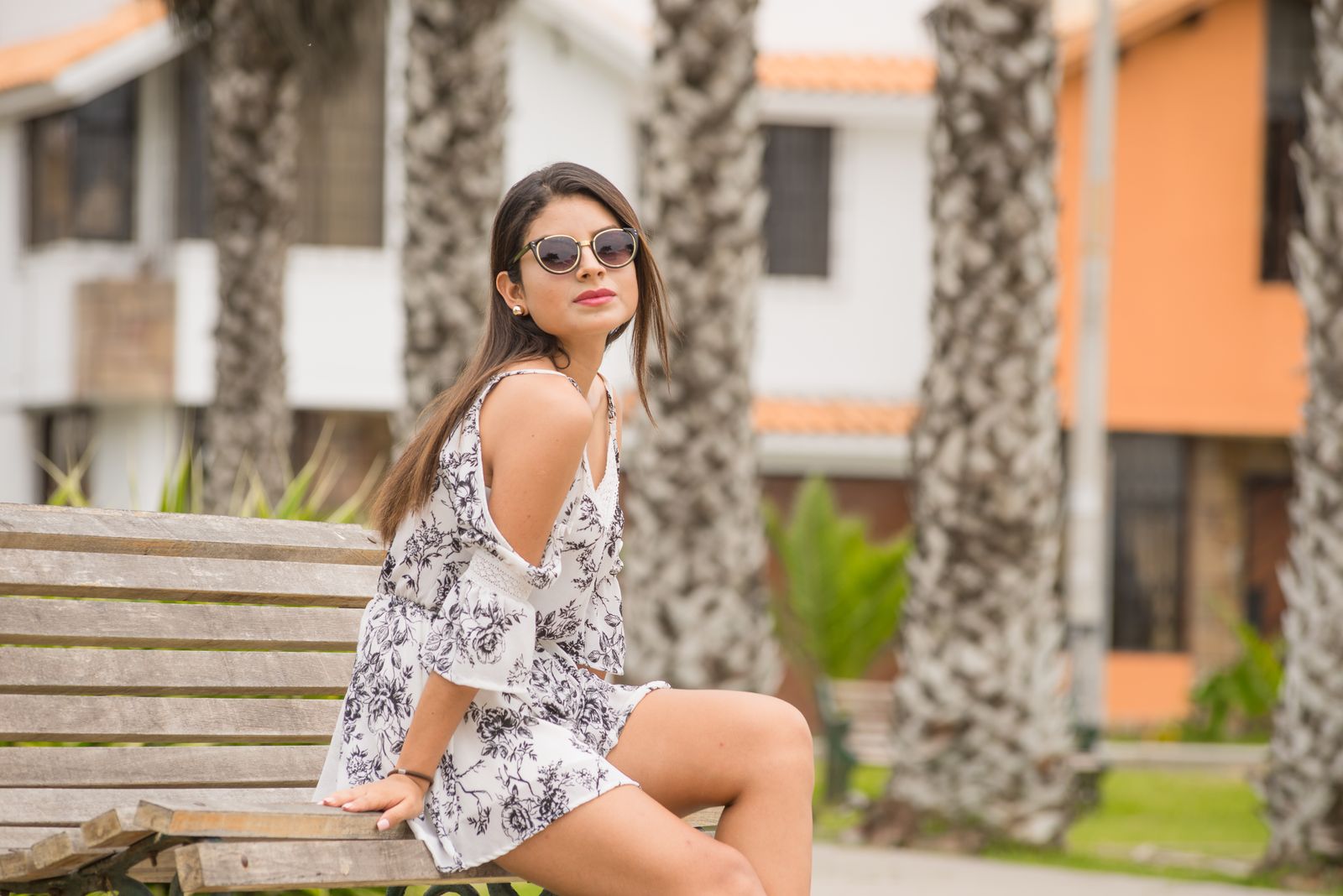
Photo by Gonzalo Sofer on Pexels
Which prints carry furthest into the season?
Prints with a dark or cream ground and at least one deep accent color transition best, because they share a palette with autumn surroundings. Multi-color florals with a warm ground work well against turning foliage. Pale pastel grounds and single-color neons are the two that stop reading correctly once the light changes, no matter how warm the day is.
Print scale is neutral here. A large bloom is as autumnal as a small one; the palette does the seasonal work. For the connection between floral prints and a softer seasonal aesthetic, see the cottagecore styling piece.
Frequently asked questions
Can you wear a sundress after Labor Day? Yes. Seasonal cutoff rules for clothing have not applied for decades, and what actually governs the choice is temperature and palette. A floral in autumn tones with tights and boots reads as an autumn outfit, not as a summer outfit worn late.
Do tights ruin the look of a slit? No, they change it. A slit over covered legs reads as movement and design rather than as exposure, which is often what makes the dress work in cooler weather. If the slit is high, opaque legwear is the more comfortable pairing.
What is the single most useful autumn addition? Closed footwear. It changes the season of an outfit faster than any other item and it solves the coldest point of contact. Legwear is a close second.
How cold is too cold for this dress? Once the daytime temperature stays below about 45 degrees, the dress becomes an indoor outfit that needs a coat for transit. That is not a failure of the garment; it is the honest boundary of a warm-weather dress, and pushing past it usually means wearing so many layers that the shape disappears.
The practical next step
Try the autumn version once before an event: the dress with semi-opaque tights, ankle boots, and a cropped layer, worn for an hour that includes going outside and coming back in. That single test tells you which layer height suits the dress and whether your legwear color works with the print, and it takes less time than deliberating about it.
Cover photo by Vika Glitter on Pexels.