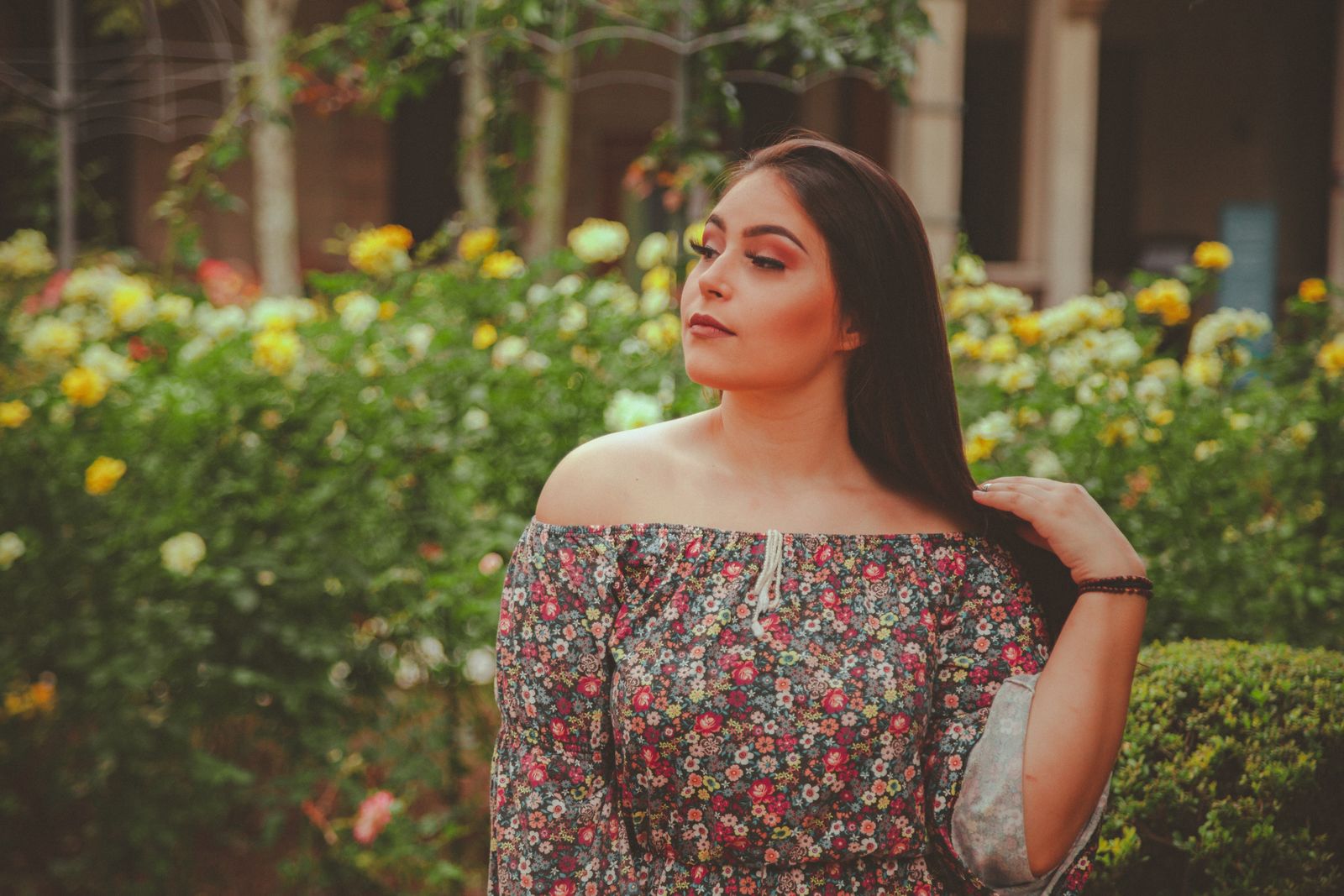
Floral Prints on Camera: Color and Palette Questions for Portrait Sessions
Floral prints photograph well when the pattern is large enough for the camera to resolve cleanly and the palette does not compete with the background. Mid-scale and larger florals read as color and movement; very fine repeating patterns can shimmer or produce a faint grid effect on digital sensors. For a portrait session, the two decisions that matter most are print scale and the relationship between the dress palette and the location.
How does print scale change the way a dress looks on camera?
Print scale determines whether the camera sees a pattern or a texture. A large or mid-scale floral keeps its identity at full length, in a half-body frame, and in a close crop. A very small, tightly repeated print starts to blur at distance and can interfere with the sensor's pixel grid, producing the faint rippling effect photographers call moiré. It is most visible in video and in tightly cropped frames.
That does not make small prints unusable. It means they belong in closer frames and softer light, while bigger prints carry a full-length shot. A colorful multi-scale floral, where blooms vary in size across the fabric, is the most forgiving of all because there is no single repeating interval for the sensor to fight with.
Silhouette matters as much as pattern. A fitted bustier top with a defined waist gives the camera a clear line to follow, so the print sits on a stable shape rather than shifting with every gust. Loose dresses move in ways that break a pattern up mid-frame. The analysis of the shaped cottagecore silhouette covers how a structured waist changes the outline the camera records.
Which color palettes work against which backgrounds?
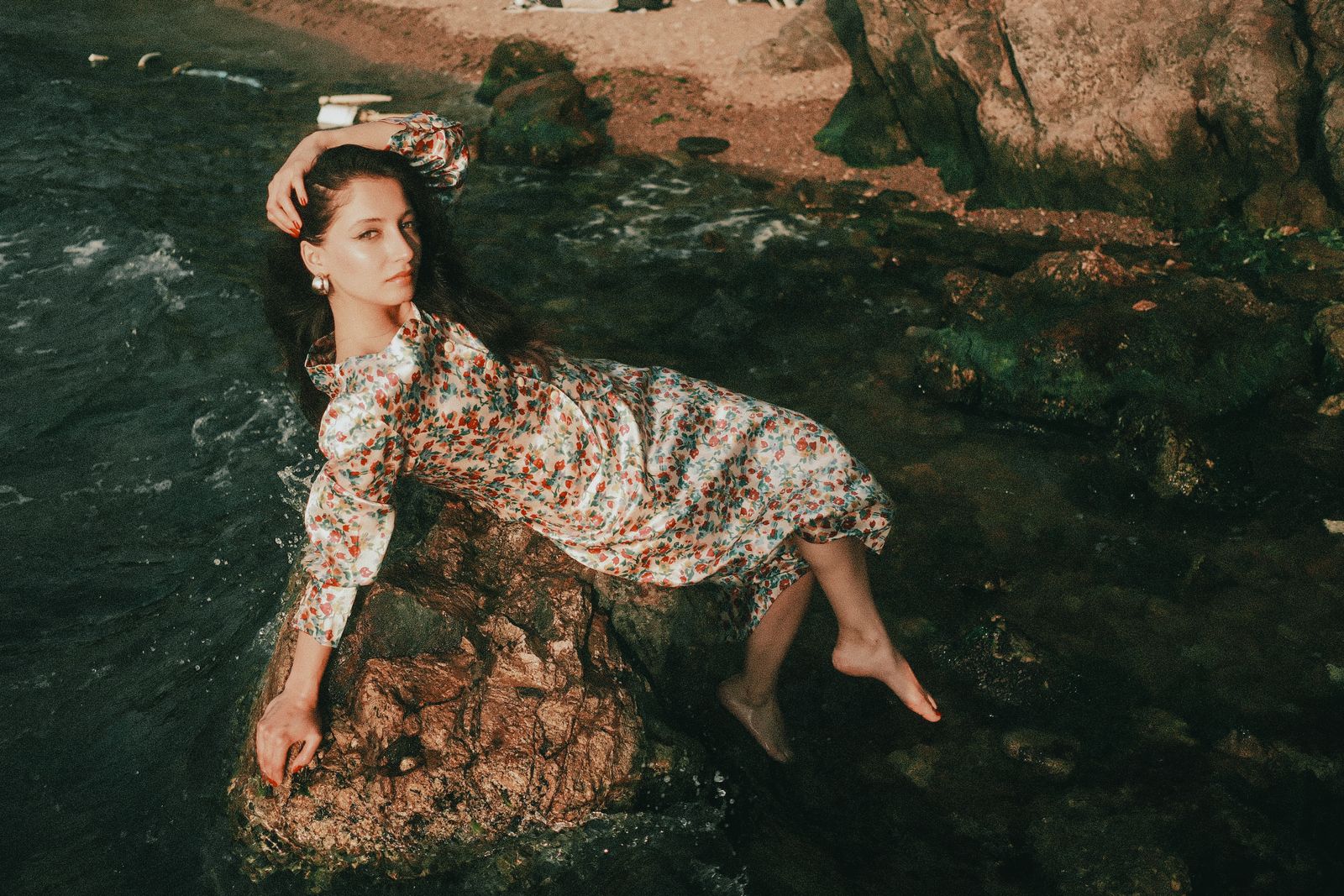
Photo by Mert Coşkun on Pexels
Match the palette to the location by contrast, not by color family. A print that shares its dominant color with the background disappears into it.
| Location | Palette that separates well | Palette to avoid | |---|---|---| | Green garden or park in summer | Warm pinks, corals, ivory grounds, deep berry | Mid-green florals on green ground | | Beach or dunes | Blues, corals, and clear brights | Sand, beige, and pale khaki grounds | | Urban stone and concrete | Saturated multi-color florals | Grey-toned pastels | | Autumn woodland | Cream ground, plum, navy, forest accents | Orange and rust prints | | Studio with a white backdrop | Anything with a defined dark or mid ground | Very pale prints with white grounds | | Golden hour, open field | Cool contrast such as blue or violet florals | Heavy yellows and golds, which flatten |
The general rule: pick a print whose background tone differs from the location's dominant tone by a visible step. Everything else is preference.
What does light do to a printed dress?
Light changes the print more than the print changes.
- Overcast daylight is the most neutral. Colors record close to how they look in person, and there are no hard shadows across the pattern.
- Open shade on a sunny day gives soft light with a slight cool cast, which suits warm palettes such as coral and pink.
- Golden hour warms everything. Warm prints go warmer and can lose separation between adjacent hues, while cool prints gain contrast.
- Direct midday sun creates hard shadows that cut across a pattern and blow out the lightest parts of a print. It is the hardest condition for busy fabric.
- Indoor mixed light shifts print colors unpredictably because household bulbs and window light have different color temperatures. Standing near a single large window is the simplest fix.
How should several people coordinate florals in one photo?
Coordinate by palette and vary by scale. When two people wear the same print at the same scale, the frame reads as a uniform. When they share two or three colors but differ in pattern size, the group looks composed.
For a session where one person is the subject and others are supporting, reverse the logic: the subject wears the print, everyone else wears quiet solids in the palette.
Which garment details actually show up in portraits?
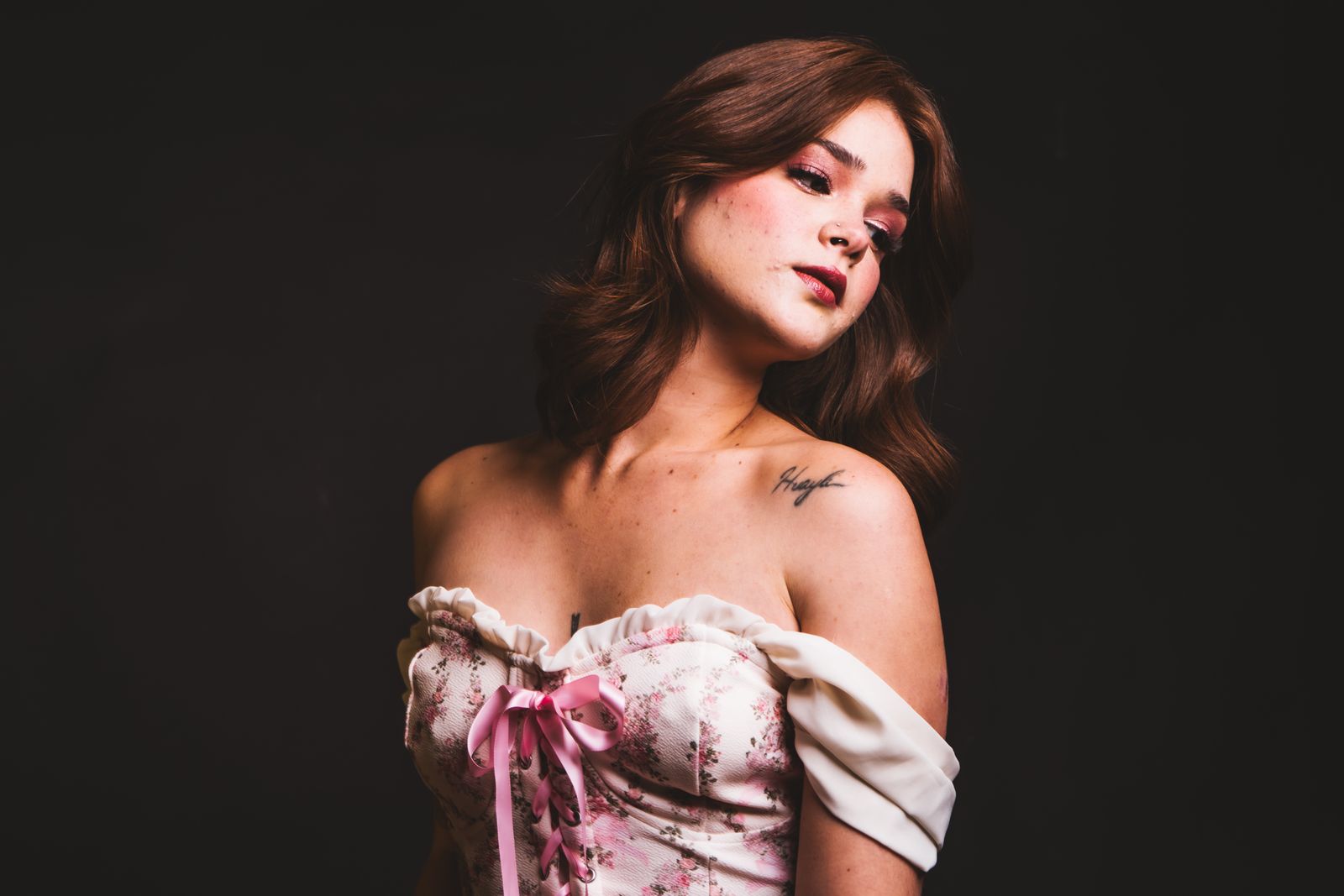
Photo by Vladimir Flores on Pexels
A short specification-style list of what the camera notices in a fitted print sundress:
- The neckline shape. A drawstring-tie sweetheart neck draws a curved line under the collarbone, which frames a necklace and gives a half-body crop something to sit on.
- The waist line. Built-in waist shaping produces a defined horizontal at the narrowest point of the outline. That line is the strongest compositional element in a full-length frame.
- The back. A lace-up back is a reason to shoot from behind, which most portrait sets never do. A single over-the-shoulder frame with the lacing visible adds variety at no cost.
- The hem and slit. A thigh-baring slit gives a walking shot a diagonal line and stops the skirt from reading as a static block.
- Pockets. Hidden pockets give hands somewhere natural to go, which resolves the most common posing problem in portraits.
- Ties and cords. Loose cord ends catch the eye in a frame. Tuck them or set them deliberately.
What should you do in the hour before a session?
For a broader set of styling combinations to try in front of a camera, the styling guide for the dress lists footwear and accessory pairings.
Frequently asked questions
Do photographers really object to patterns? Some prefer solids because solids are predictable, but a good print gives a portrait color and season that a solid cannot. The objections that hold up are practical: very fine repeats can shimmer, and neon shades throw colored light onto skin in bright sun. Mid-scale florals in natural tones cause no trouble.
Will a busy floral look dated in ten years? Less than a trend-led silhouette will. Botanical prints have been in warm-weather photographs for a century. What dates a picture is usually the styling around the dress, such as footwear and hair, rather than the pattern itself.
Is it better to bring two dresses or one? One dress plus two accessory sets beats two dresses for most sessions. Changing shoes and jewelry gives the set variety without losing the twenty minutes it takes to change and re-set a fitted bodice, and the frames stay coherent as a group.
How do you avoid looking stiff in a fitted dress? Move between frames rather than holding a pose. Walking shots, turning shots, and hands-in-pockets frames all read as relaxed, and a defined waist keeps the outline clean while you move. The confidence and style piece on midriff dresses covers the same ground away from the camera.
The practical next step
Before booking a location, photograph the dress on a phone in two lighting conditions on the same day: open shade in the morning and golden hour in the evening. Those two frames tell you which palette the print prefers and what time of day to ask for, which is more useful than any general rule about patterns.
Cover photo by Lucas Pezeta on Pexels.